


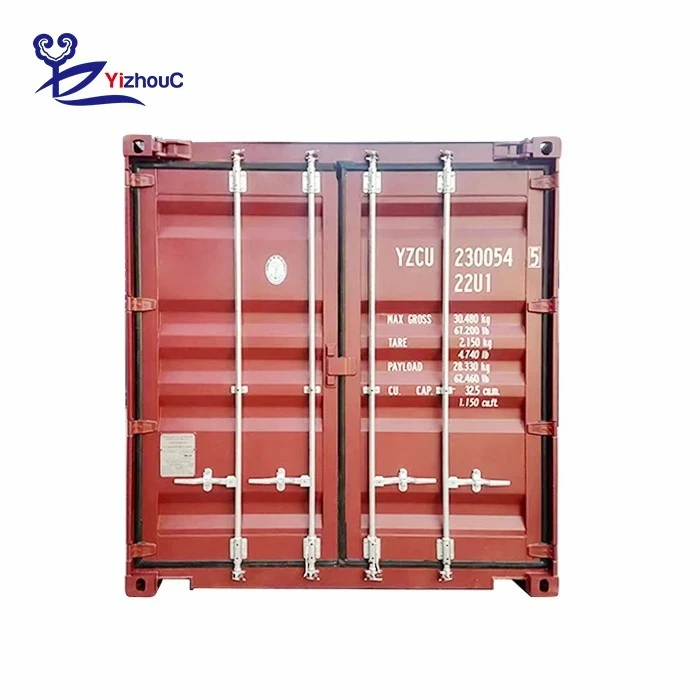
Customized High Cube Cargo Container: Engineering & Manufacturing Specifications
Product Identification & Variants
Standard high-cube cargo containers provide an extra foot of vertical height compared to standard dry vans. Custom variants alter the base ISO structure to meet specific mechanical, spatial, or environmental engineering requirements.
40ft High Cube Customized (40' x 8' x 9'6"): Industry baseline for volumetric cargo and bulk equipment integration.
45ft High Cube Customized (45' x 8' x 9'6"): Extended payload capacity for low-density industrial goods or expansive internal system layouts.
Modified Structural Variants: Units engineered with removable side panels, reinforced roof structures, ISO corner castings repositioned for specific lifting gear, or partitioned internal bulkheads.
Technical Specifications & Material Standards
Engineering custom containers requires strict adherence to international structural and metallurgical standards. The table below outlines our standard baseline specification for heavy-duty customized builds.
|
Parameter |
Specification Data |
Industrial Standard / Test Method |
|
External Dimensions |
12,192 mm × 2,438 mm × 2,896 mm (40' HC) |
ISO 668 |
|
Internal Clearances |
Length: 12,032 mm |
Width: 2,352 mm |
|
Max Gross Weight (Rating) |
30,480 kg to 32,500 kg (Project dependent) |
CSC Safety Convention |
|
Tare Weight |
Approx. 3,900 kg – 4,400 kg (Varies by modification scope) |
ISO Tolerance +/- 2% |
|
Structural Steel Grade |
JIS SPA-H Weathering Steel (Cor-Ten A equivalent) |
ASTM A588 / Equivalent |
|
Corner Castings |
JIS SCW 480 cast steel |
ISO 1161 |
|
Flooring |
28 mm Marine-grade waterproof Apitong / Keruing plywood |
Treatment: Insecticide treated per AQSIQ |
|
Surface Preparation |
Abrasive blast cleaning to ISO 8501-1 Sa 2.5 |
Surface profile: 40-75 um |
|
Paint System |
Zinc-rich epoxy primer (50 um) + Intermediate epoxy (100 um) + Polyurethane topcoat (50 um) |
Total DFT >= 200 um; Salt spray resistance >= 1,000 hours (ASTM B117) |
Application & Deployment Analysis
Custom high cube containers serve critical industrial roles where standard boxes fail due to clearance constraints or specialized integration needs.
Battery Energy Storage Systems (BESS): Enclosures designed with integrated HVAC ducting, structural floor loading reinforcements (up to 20 kN/m2 for heavy battery racks), and arc-resistant ventilation louvers.
Mobile Power Generation Units: Diesel generator housings featuring acoustic insulation baffles, exhaust penetrations with thermal shielding, and internal fuel tank mounting channels.
Remote Industrial Workshops & Laboratories: Insulated units featuring polyurethane (PU) or rockwool sandwich panel interior linings, electrical distribution raceways, and HVAC penetrations.
Oversized Cargo Logistics: Modified side-opening or open-top high cube frames built to transport industrial machinery requiring overhead crane loading.
Manufacturing Process, Quality Control & Visual Verification
Material Verification
Incoming structural steel plates and JIS SCW 480 corner castings undergo chemical composition verification via spectrometer analysis and tensile strength testing prior to cutting.
Precision Cutting & Forming
Visual Evidence: [CNC Plasma Cutting & 500-Ton Press Brake Forming In-House]
CNC plasma cutting tables and 500-ton hydraulic press brakes process corrugated wall panels (1.6mm to 2.0mm thickness) and roof profiles, ensuring strict dimensional repeatability for automated jig assembly.
Automated & Certified Welding
Visual Evidence: [AWS D1.1 Certified FCAW/GMAW Welding & UT/MT NDT Testing Workflow]
Structural frame welding (corner posts, floor crossmembers, top/bottom side rails) is executed by certified welders adhering to AWS D1.1 / ISO 9606 standards using Flux-Cored Arc Welding (FCAW) and Gas Metal Arc Welding (GMAW) processes. Non-Destructive Testing (NDT) via ultrasonic testing (UT) and magnetic particle testing (MT) is applied to critical structural joints.
Rigorous Testing Protocol
Every custom container undergoes comprehensive structural and weatherproofing verification:
Strap Lifting Test: Evaluates vertical lifting capacity via top corner castings under full rated load.
Floor Strength Test: Concentrated load testing using a 7,260 kg truck axle footprint.
Watertightness Test: Visual Evidence: [0.1 MPa High-Pressure Water Jet Test Bay]. High-pressure water jet testing (0.1 MPa nozzle pressure at a distance of 1.5 meters) across all welds and door gaskets to guarantee zero moisture ingress.
Compliance & Certifications
To ensure seamless global deployment and intermodal transport clearance, our manufacturing facilities and containers comply with:
CSC (International Convention for Safe Containers): Safety approval plate issued by classification societies (ABS, BV, LR, DNV, or CCS).
ISO 668 & ISO 1496: Standard series freight containers classification, specification, and testing.
TIR (Transport International Routier): Customs clearance compliance for international road transport.
ISO 9001:2015: Quality Management System for design, manufacturing, and inspection workflows.
Supplier Assessment Guide
When evaluating manufacturing partners for custom high cube containers, engineering procurement teams should verify the following capabilities:
Engineering Review Capability: Can the supplier provide finite element analysis (FEA) reports for heavy structural modifications (e.g., large side-wall cutouts)?
Traceability: Do they provide full material mill test certificates (MTCs) for structural steel and corner castings?
Welding Qualification Records: Are welder performance qualifications (WPQ) and welding procedure specifications (WPS) verifiable by third-party inspection agencies?
Customization Flexibility: Does the factory maintain in-house tooling for non-standard corrugated profiles and custom door placements?
Procurement Decision Framework
Structuring an efficient RFQ for custom high cube containers requires clear parameter definitions to eliminate lead-time delays:
Define Operating Environment: Specify coastal (high salt fog), arctic (low-temperature impact toughness down to -40°C), or desert operating conditions to dictate steel grade and paint specifications.
Specify Structural Modifications: Detail cutouts, reinforcements, partition walls, cable penetrations, or mounting brackets via 2D/3D CAD drawings (STEP/DWG format).
Establish Compliance Requirements: Clarify whether the unit requires standard CSC transport certification, DNV offshore rating, or specific electrical/fireproofing standards (e.g., UL, CE).
Determine Inspection Milestones: Define third-party inspection (TPI) hold points (e.g., steel prep check, weld NDT, final dimensional audit) prior to factory release.
Request a Technical Quotation
To initiate an engineering review and quotation for your custom high cube container project, please prepare the following parameters for our technical sales engineering team:
Base Container Type (40' HC, 45' HC, or custom length)
Required Internal/External Clearances
Payload Capacity and Concentrated Floor Loading Requirements
Modification Drawings or Functional Description (HVAC, electrical, doors, partitions)
Target Delivery Port and Required Compliance Certifications (CSC, ABS, BV)
FAQ
Hot Tags: customized high cube cargo container, China customized high cube cargo container suppliers, factory


